
- High-Quality Torx Screws & Custom Star Drive Fasteners | FASTKING
- sales@jlfastener.com

Internal plum stop top screw DIN34827
Torx set screw
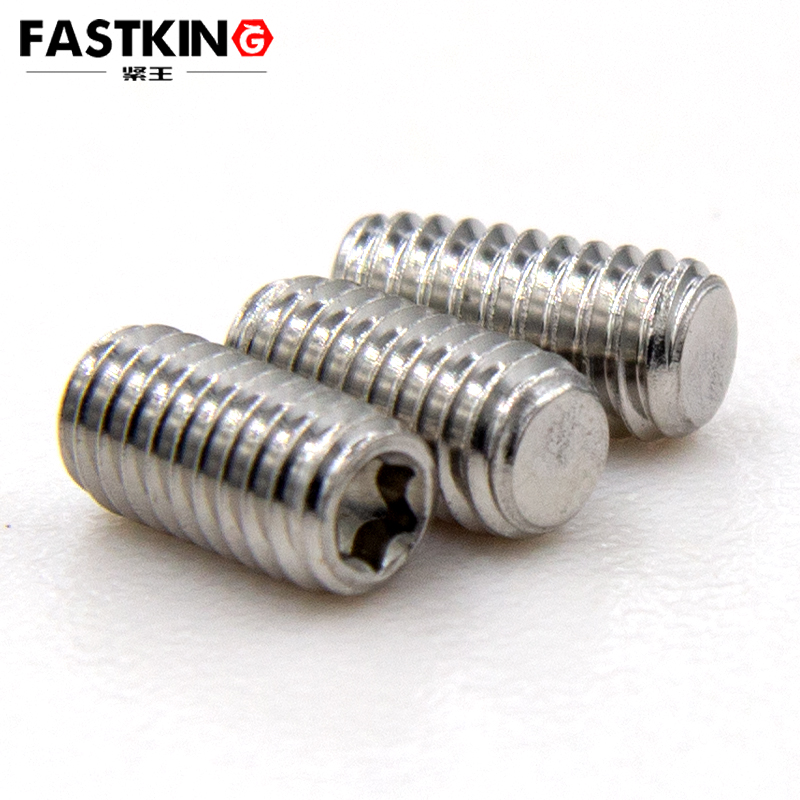
Flat-end plum blossom groove set screw
- Description:
The flat-end internal Torx set screw DIN34827 is a precision fastener complying with the German DIN34827 standard, belonging to the category of set screws. Its core purpose is to fix the relative position of mechanical parts and achieve limit locking. With its unique structural design and standardized precision, it is widely used in precision machinery, electronic equipment, automatic instruments and other scenarios that require high assembly precision and anti-loosening performance. As a special set fastener, it is different from ordinary machine screws. It does not require matching nuts, and achieves fixation by screwing into the workpiece screw hole and pressing the flat end against the surface of another mechanical part. It is an indispensable key component in industrial precision assembly. The following comprehensively analyzes its core value and practical specifications from five aspects: standard characteristics, structural advantages, application scenarios, selection points and usage precautions.
The DIN34827 standard is the core technical benchmark for this set screw, which clearly specifies its dimensional accuracy, material requirements, mechanical properties and appearance standards, ensuring product versatility and interchangeability. Compared with ordinary set screws, the core advantages of the flat-end internal Torx set screw DIN34827 focus on structural design, combining operational convenience, anti-loosening performance and workpiece protection. Its head adopts an internal Torx slot design. Compared with cross slots and slotted slots, it has stronger anti-slip performance, which can effectively avoid wrench slipping during operation and transmit torque more evenly. At the same time, the hidden design of the internal Torx slot does not occupy additional space, making it suitable for narrow installation scenarios, and can prevent foreign objects from colliding and damaging the slot, extending the service life.
The flat-end design is its distinctive feature. Different from ball-end and cone-end set screws, the end of its screw rod is a flat end face, which is in surface contact with the surface of the fixed mechanical part, with uniform force. It can effectively avoid scratching the surface of the workpiece by the sharp end face, especially suitable for fixing mechanical parts with high hardness or frequent position adjustment. At the same time, it can improve the locking stability and prevent loosening hidden dangers caused by long-term vibration. In addition, the set screw adopts a full machine thread design with regular threads and high precision, complying with the thread tolerance of the DIN standard. It can be screwed in smoothly and closely, accurately control the fastening force, and realize precise limit and fixation.
In terms of materials and surface treatment, the flat-end internal Torx set screw DIN34827 complies with standard requirements, and the commonly used materials are carbon steel, alloy steel and stainless steel. Carbon steel material is cost-effective, with moderate strength after heat treatment, suitable for ordinary dry scenarios; alloy steel materials (such as 8.8 grade, 10.9 grade) have higher tensile strength and hardness, suitable for medium and high load scenarios; stainless steel materials (such as 304, 316) have excellent corrosion resistance, suitable for humid and mild corrosion environments, meeting the cleanliness and corrosion resistance requirements of electronics, chemical and other fields. Surface treatment mostly adopts blackening, galvanizing, passivation and other processes to further improve corrosion resistance and surface smoothness, avoiding rust affecting assembly precision.
Based on its standardized precision and structural advantages, the application scenarios of this set screw focus on the field of precision assembly. In precision instruments and electronic equipment, it is used to fix gears, bearings, shaft parts. The flat-end design protects precision components from damage, and the internal Torx slot is convenient for operation in narrow spaces; in automatic equipment and machine tools, it is used for positioning and locking of guide rails and sliders. With stable locking performance, it ensures that the position of components is accurate during equipment operation and avoids deviation; in auto parts and molds, it is suitable for fixing parts that need frequent position adjustment. The flat-end surface contact can improve the stability after adjustment, and the anti-loosening performance can resist vibration during equipment operation. In addition, in fields such as medical equipment and small motors, its precision and adaptability can also meet high-end assembly needs.
Selection and use must strictly follow the DIN34827 standard to ensure adaptability and safety. During selection, it is necessary to match the thread size and screw length according to the workpiece screw hole specification, clarify the pitch and precision grade, and avoid assembly loosening or inability to screw in due to inconsistent sizes; select products with corresponding materials and surface treatment according to working conditions, loads and environments, and prefer stainless steel materials in humid environments; at the same time, confirm the internal Torx slot specification and match it with a special Torx wrench to ensure smooth operation. During use, it is necessary to clean the impurities on the screw hole and the contact surface of the workpiece to avoid affecting the fit; control the fastening torque to avoid thread slipping or workpiece damage caused by over-tightening; regularly check during long-term use, and replace in time if rust or slipping occurs to ensure stable locking performance.
In summary, relying on the standardized precision of the DIN standard and the structural advantages of the internal Torx slot and flat end, the flat-end internal Torx set screw DIN34827 has become the preferred fastener in the field of precision assembly. It has the characteristics of convenient operation, strong anti-loosening performance and good workpiece protection, which accurately adapts to the positioning and locking needs of various precision equipment. Reasonable selection and standardized use can give full play to its standardized advantages, ensure the assembly precision and long-term stable operation of equipment, and provide reliable support for industrial precision manufacturing.