
- High-Quality Torx Screws & Custom Star Drive Fasteners | FASTKING
- sales@jlfastener.com

Flat head wood screw self-tapping screw
Torx tapping screw
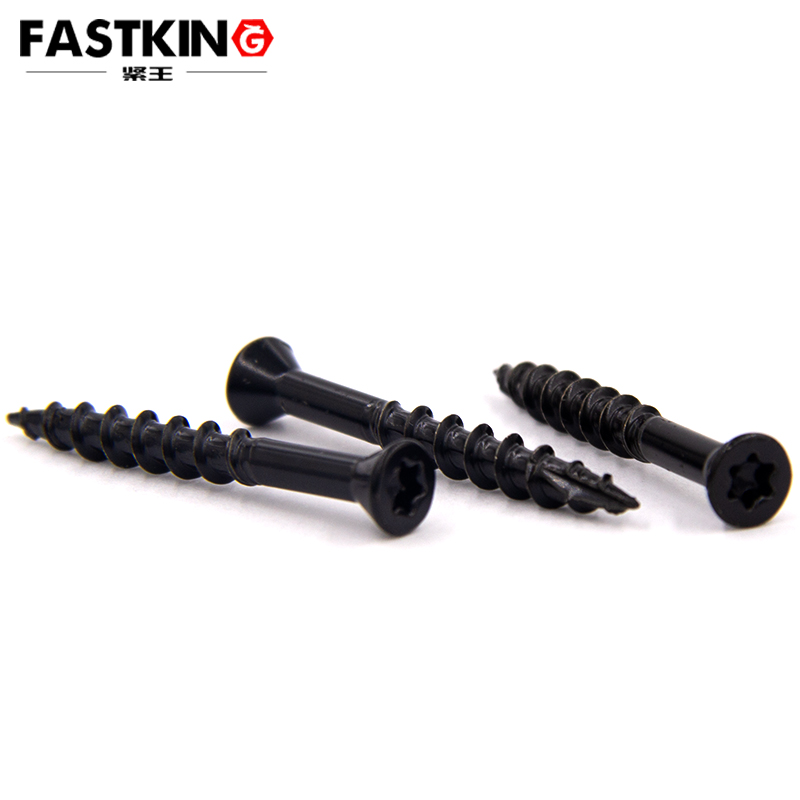
304 countersunk internal Torx fine-thread half-thread self-tapping screw, electrophoresed black
- Description:
The 304 countersunk internal Torx thin shank half-thread cut tail self-tapping screw with black electrophoresis is a special fastener integrating multiple structural advantages and anti-corrosion properties. It combines the corrosion resistance of 304 stainless steel, the convenient operability of the internal Torx slot, the flat adaptability of the countersunk head, the precise adaptability of the thin shank and half-thread, and the convenient assembly of the cut tail self-tapping. Equipped with black electrophoresis surface treatment, it not only improves anti-corrosion performance but also ensures a clean appearance. It is widely used in precision electronics, furniture assembly, light industry equipment, outdoor decoration and other scenarios with clear requirements for corrosion resistance, aesthetics and assembly precision. As a multi-functional self-tapping fastener, it does not require pre-tapped threaded holes and can be directly screwed into the workpiece to achieve fixation. Different from ordinary machine screws and conventional self-tapping screws, it has become a preferred product balancing practicality, corrosion resistance and aesthetics by virtue of its unique structural design and material advantages. The following comprehensively analyzes its core value and practical specifications from five aspects: core product characteristics, structural advantages, application scenarios, selection points and usage precautions.
The 304 stainless steel material is the core competitiveness of this screw, laying a solid foundation for its excellent corrosion resistance. Made of standard 304 stainless steel, this screw contains more than 18% chromium and 8% nickel in its chemical composition. It has an austenitic structure and no magnetism at room temperature, with excellent corrosion resistance, heat resistance and processability. It can maintain stable performance in ordinary atmosphere, humid environment and mild acid-base environment, and is not easy to rust or corrode. Compared with ordinary carbon steel self-tapping screws, its service life is greatly extended, especially suitable for scenarios requiring cleanliness and corrosion resistance, such as outdoor decoration and equipment assembly in humid environments. At the same time, 304 stainless steel has good toughness and processability, which can be accurately made into complex structures such as countersunk head, internal Torx slot, thin shank, half-thread and cut tail, balancing strength and adaptability. Its nominal tensile strength can reach about 520MPa, and the yield strength is about 205MPa, which meets the needs of most conventional load scenarios and avoids the hidden dangers of deformation, fracture or thread slipping during long-term use.
In terms of structural design, this screw integrates multiple advantages, and each design is in line with practical needs, different from ordinary self-tapping screws. The countersunk head design is its distinctive feature. The head is conical, and after being tightened, it can be completely embedded in the workpiece surface to form a flat connection surface without protrusions or obstacles. It not only improves the aesthetics of assembly but also avoids damage caused by collision of the head, making it suitable for scenarios requiring surface flatness, such as furniture panels, electronic equipment casings and decorative panels, while reducing the risk of external interference and wear. Compared with cross slots and slotted slots, the internal Torx slot design has stronger anti-slip performance, which can effectively avoid wrench slipping during operation and transmit torque more evenly. At the same time, the hidden design of the internal Torx slot does not occupy additional space, making it suitable for narrow installation scenarios, and can prevent foreign objects from colliding and damaging the slot, extending the service life. It also has a certain anti-theft performance and requires a special Torx wrench for operation to avoid arbitrary disassembly by non-professionals.
The thin shank, half-thread and cut tail design highlight the convenience and adaptability of its self-tapping assembly. Compared with conventional thick-shank screws, the thin shank design has a smaller shank diameter, which can reduce damage to the workpiece, especially suitable for fragile substrates such as thin-walled workpieces, plastic parts and thin steel plates. It also saves installation space and is suitable for assembly scenarios with narrow gaps; the half-thread design means that the screw shank is partially threaded and the tail is unthreaded, which not only ensures the tightness of thread engagement but also avoids the resistance when full-thread screws are screwed in, improving assembly efficiency. It is also suitable for scenarios requiring partial positioning and partial fastening. The cut tail design is the core of the self-tapping function. The tail of the screw is specially cut to form a sharp cutting edge. It can be directly screwed into the workpiece and tap threads by itself without pre-drilling and tapping holes in the workpiece, realizing drilling, tapping and fastening in one step, greatly improving assembly efficiency. It is suitable for various substrates such as wood, plastic and thin steel plates, meeting the assembly needs of different scenarios.
The black electrophoresis surface treatment is a characteristic advantage of this screw, balancing corrosion resistance and aesthetics. The electrophoretic coating process deposits black paint particles evenly on the surface of the screw through the action of an electric field, forming a dense and uniform protective coating with a thickness usually between 5-30μm, free of pinholes, bubbles and other defects. It has extremely strong adhesion, far higher than ordinary spray painting or electroplating, and is not easy to fall off or fade due to slight friction or collision. This coating can not only effectively isolate corrosive substances such as air, water vapor and oil, further improving the corrosion resistance of 304 stainless steel and extending the service life of the screw, but also make the surface of the screw present a uniform matte black color, with a clean appearance and outstanding texture. It is suitable for scenarios requiring decorative appearance, such as high-end furniture, outdoor decoration and electronic equipment casings, and can hide assembly traces, improving the overall assembly texture. High-quality black electrophoretic coating can maintain a black appearance for a long time without fading under normal indoor environment, without severe friction or corrosion.
Based on the dual advantages of material and structure, the application scenarios of this screw cover many fields, accurately matching the corrosion resistance, aesthetics and convenient assembly needs of different working conditions. In the field of precision electronics and home appliances, it is used to fix electronic components, equipment casings, panels, etc. The thin shank design protects thin-walled substrates from damage, the countersunk head design ensures surface flatness, the internal Torx slot is suitable for operation in narrow spaces, and the black electrophoresis appearance matches the equipment casing, improving product texture; in the field of furniture assembly, it is suitable for fixing panels and brackets of wooden furniture and panel furniture. The cut tail self-tapping function does not require pre-drilling, avoiding wood cracking. The thin shank and half-thread design is suitable for thin-walled parts of furniture, and the black electrophoresis can match various furniture styles, balancing aesthetics and practicality; in the field of light industry equipment, it is used to fix internal components of small machinery and instruments, adapting to narrow installation spaces. The corrosion resistance of 304 material can avoid rust in humid environments, ensuring stable operation of equipment; in the field of outdoor decoration, it is used to fix guardrails, decorative panels, door and window accessories. The double anti-corrosion of 304 material and black electrophoresis can resist outdoor wind and rain erosion, not easy to rust and fade, and is beautiful and clean; in addition, in fields such as medical equipment and toy manufacturing, its characteristics of cleanliness, corrosion resistance and convenience can also meet high-end assembly needs.
Key details must be grasped during selection and use to ensure the best performance of the product and avoid assembly failure caused by improper selection and irregular operation. During selection, it is necessary to match the screw specification according to the workpiece substrate and installation space, clarify the thread size, screw length and thin shank diameter, and ensure that the cut tail design is suitable for the substrate (wood, plastic, thin steel plate, etc.), avoiding inability to screw in or loose fixation due to inconsistent specifications; confirm the demand according to the working condition environment. If it is in a severe corrosion environment (such as coastal and chemical strong corrosion scenarios), additional passivation treatment can be matched to further improve corrosion resistance; at the same time, confirm the internal Torx slot specification and match it with a special Torx wrench to ensure smooth operation. During use, it is necessary to clean the oil, impurities and wood chips on the workpiece assembly surface to avoid affecting thread engagement and fit; control the screwing force according to the hardness of the substrate, avoid thread slipping, workpiece damage or screw breakage caused by over-tightening, especially for fragile substrates such as plastic and thin steel plates, torque must be controlled; avoid using ordinary screwdrivers to prevent wear of the internal Torx slot, affecting subsequent disassembly; for screws long-term exposed to outdoor or humid environments, regularly check the state of the surface electrophoretic coating. If the coating is damaged or slightly rusted, simple cleaning and touch-up can be carried out, and replace in time when severely rusted; store in a dry and ventilated environment, avoid humidity and exposure to the sun, and prevent the electrophoretic coating from falling off or the material performance from being damaged.
In summary, relying on the corrosion resistance of 304 stainless steel, the adaptability and convenience of multiple structures, and the anti-corrosion and aesthetic characteristics of black electrophoresis, the 304 countersunk internal Torx thin shank half-thread cut tail self-tapping screw with black electrophoresis has become a high-quality fastener balancing practicality, corrosion resistance and aesthetics. Whether in scenarios requiring precision and appearance such as precision electronics and high-end furniture, or scenarios requiring corrosion resistance such as outdoor decoration and humid environments, it can be accurately adapted to provide reliable connection guarantee for the stable operation of equipment and structures. Reasonable selection and standardized use can not only maximize its service life but also improve assembly efficiency, aesthetics and connection safety.
- PREVIOUS:Flat-end plum blossom groove set screw
- No next